



PESTS AND DISEASES OF FORESTRY IN NEW ZEALAND
Paropsis charybdis, Eucalyptus tortoise beetle
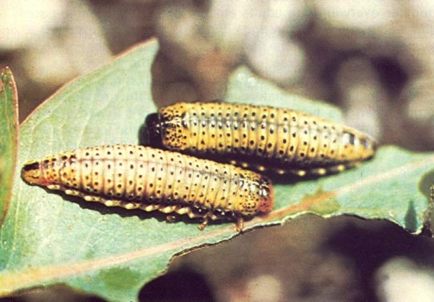
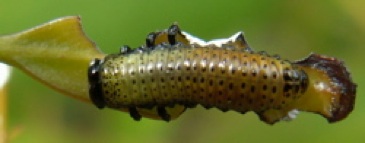
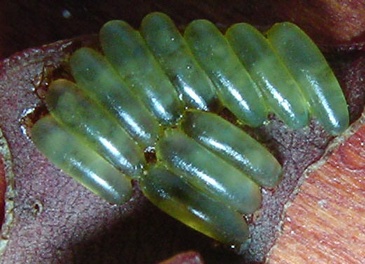
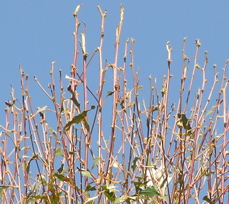
Paropsis charybdis, the eucalyptus tortoise beetle, has been defoliating eucalypts in New Zealand since just after the turn of last century.
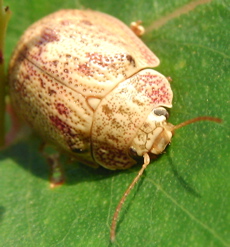
This beetle is the most serious defoliater of eucalypts in New Zealand, but is normally only a serious problem for one group of eucalypts, those belonging to the subgenus called Symphyomyrtus. It can be quite difficult to categorise levels of attack to each species because sometimes strains within a species are more susceptible.
The most severely attacked species include:
E. globulus, E. viminalis, E. johnstonii, E. smithii, E. grandis, E. deanei, E. guilfoylei, E. macarthurii, E. longifolia, E. quadrangulata, E. dunnii, E. resinifera, E. scias, E. pellita, E. guilfoylei, E. leucoxylon and E. melliodora.
Other species sometimes subject to attack include E. saligna, E. botryoides, E. robusta, E. bosistoana, E. rummeryi, E. propinqua, E. punctata, E. diversicolor, E. camaldulensis, E. teretecornis, E. brookerana, E. nitens, E. bicostata, E. maidenii and E. ovata.
However, some species such as E.nitens, which is not usually severely attacked by Paropsis, can be subject to severe attack and defoliation when in a plantation situation. E.nitens is widely grown in New Zealand for wood fibre in large plantations and Paropsis is considered to be the most serious threat to the industry.
Some eucalypts belonging to the other common subgenus, Monocalyptus, (ashes and stringybarks) are browsed by the adult beetles, resulting in minor, characteristic "scalloping" of older, mature leaves, but without the more serious damage to new growth caused by Paropsis larvae. Such browsing is often seen on E. fraxinoides, E. muelleriana, E. obliqua, and E. regnans.
A parasitoid wasp Ennogera nassaui gave good biological control of Paropsis charybdis after it was released in the 1980's. However, in recent years it, in turn, has been parasitised by a hyperparasitoid, Baeoanusia albifuncle which has unfortunately arrived from Australia and very specifically attacks eggs of P. charybdis already parasitised by Ennogera. To further complicate things, fortunately there is now another parasitoid in New Zealand Neopolycyctus insectifurax that also attacks P. charybdis. Although this insect affords some control over P. charybdis, defoliation of susceptible eucalypts remains high.
Many of the eucalypt species susceptible to Paropsis could be commercialised if an adequate level of control over Paropsis was achieved. In particular, for warmer areas, E. scias red mahogany because of its quality timber suitable for high value end uses and E. quadrangulata white-topped box, for its extremely durable timber, excellent form and fast growth. Colder climate species such as E. johnstonii, E. nitens and E. globulus could regain favour if biological control of Paropsis was to prove successful.
Dean Satchell
4/4/10
Articles and Reports
- The eucalyptus tortoise beetle Paropsis charybdis in New Zealand
Forest and Timber Insects in New Zealand No. 10: Eucalyptus tortoise beetle. Revised 2009 (J. Bain, T. Murray, L.A. Berndt, B. Gresham) Limited revision 2001 Based on J. Bain (1977) Insect:…
- Introducing Eadya daenerys -Mother of Dragons” - a new biocontrol agent in NZ’s fight against the invasive eucalyptus tortoise beetle
In this You-tube clip University of Tasmania entomology associate professor Dr Geoff Allen and Scion entomologist Roanne Sutherland, discuss a joint biological control initiative between Scion New Zealand and the… - Good news for eucalypt growers - The approved release of Paropsis charybdis bio-control agent
Toni Withers and Michelle Harnett, New Zealand Tree Grower Magazine May 2019. The approval to release the parasitoid wasp Eadya daenerys to control eucalyptus tortoise beetle Paropsis charybdis by New Zealand’s Environmental Protection… - Good news for biocontrol of eucalyptus tortoise beetle
From Forest Health News 287, March 2019. Scion entomologist Toni Withers was delighted last week to get the news she had been waiting for from the Environmental Protection Authority. Scion’s… - Biological control of Paropsis charybdis in New Zealand using Eadya daenerys
Watch a 5 minute video on the biological control of Paropsis charybdis in New Zealand using Eadya daenerys No posts yetAdd a post - Introducing Eadya daenerys “mother of dragons”
From Forest Health News 282, July 2018. The possibility of cryptic Eadya species (multiple species that look identical) spurred a collaborative project between biocontrol scientists at Scion, the University of Tasmania… - Protecting our Eucalyptus trees
May 2018. Scion are undertaking community pre-consultation on a proposed biological control of the Eucalyptus tortoise beetle. Eucalyptus plantations are a recognisable part of New Zealand’s diversified forestry industry. They provide… - Pre application consultation has begun for a new potential biological control introduction to control Eucalyptus tortoise beetle, Paropsis charybdis
April, 2018. Background The Farm Forestry Association, and Scion have been collaborating for the last 5 years on a project to get a new biological control agent into New Zealand… - Hunt for the wilderbeetles
From Forest Health News 280, March 2018. Scion entomologists and ecologists spent three weeks in Kahurangi National Park this last summer with a DOC permit to search for a group… - Tasmanian Parasitoid of Tortoise Beetle Holds Promise
From Forest Health News 272, April 2017. Scion entomologists and summer students have been working hard on the Paropsis biocontrol project this summer. The aim of this project, last featured in… - Update on Paropsis biocontrol December 2016
December, 2016. The parasitoid wasp Eadya paropsidis remains a strong candidate for safe release as a biological control agent for Eucalyptus tortoise beetle in New Zealand. Eadya paropsidis has been… - Update on SFF Paropsis biocontrol project May 2016
May, 2016. The Tasmanian parasitoid wasp, Eadya paropsidis, is being investigated as a potential biological control agent for Paropsis charybdis, the Eucalyptus tortoise beetle. The first year of the three… - Tasmanian parasitoid keeps entomologists busy in Rotorua containment facility
From Forest Health News 263, December 2015 - January 2016. The first ever observed mating pair of the parasitoid Eadya paropsidis. Females are haplo-diploid and need to be mated to produce… - Great news for tortoise beetle biocontrol - Sustainable Farming Fund application successful!
From Forest Health News 258, July 2015. In the February issue we introduced readers to Eadya paropsidis, the exciting Tasmanian parasitoid that attacks larvae of the tortoise beetle, Paropsis charybdis.… - New potential biological control agent arrives in containment
From Forest Health News 253, January/February 2015. Eadya paropsidis female stalks its prey and delivers one egg into the Paropsis larva’s body. Photo: S. Kirk, Scion. In December, Forest Protection… - New Work on Biological Control for Eucalyptus Tortoise Beetle
January, 2015. LATEST NEWS: Promising Biological Control agent imported into Containment On December 12th 2014, NZFFA representative on the SFF project team Dean Satchell brought back from Tasmania an exciting… - Scion granted permission to import a new parasitoid for testing
From Forest Health News 250 , September 2014. For the last two years entomologist Toni Withers has been working on a collaborative Sustainable Farm Fund project led by the Farm… - NZFFA eucalypt tortoise beetle biocontrol progress
July, 2014. A parasitoid wasp of the spring-time larval stage of the eucalyptus leaf beetle Paropsisterna agricola in Tasmania has had its identity confirmed and is the most exciting potential… - Dean Satchell heads to Tasmania to assist with mass-rearing Eadya paropsidis, the potential biological control agent of Paropsis charybdis
December, 2013. Despite considerable efforts, the eucalyptus tortoise beetle Paropsis charybdis (paropsis) continues to defoliate Eucalyptus nitens plantations throughout New Zealand. The pest both prevents expansion of this forest resource… - Results of the first year of a Sustainable Farming Fund study to locate a spring-active parasitoid in Tasmania
for potential biological control of Paropsis charybdis August, 2013. Despite considerable efforts, the eucalyptus tortoise beetle Paropsis charybdis continues to defoliate Eucalyptus nitens plantations throughout New Zealand. This pest both… - Mitey promising biological control agent for Paropsis charybdis?
From Forest Health News 235, April 2013. A collaboration with Australian forest entomologist Dr Helen Nahrung from the University of the Sunshine Coast, Queensland, has yielded new information. Dr Nahrung… - Biological control of Paropsis charybdis
From Forest Health News No. 232, January 2013. Eadya attacking paropsine larva Toni Withers, with technical assistance from Hannah Fluitsma (Southwood Export) and Dean Satchell (Farm Forestry Association), were in Tasmania… - Biological control of Paropsis charybdis
From Forest Health News 227, July 2012. Paropsine beetles (Coleoptera: Chrysomelidae) are extremely diverse and abundant in their native Australian range but have emerged as significant defoliators only since the… - New work on biological control for Eucalyptus tortoise beetle
Investigating the potential of Eadya paropsidis (Braconidae) from Tasmania as a biocontrol agent for Paropsis charybdis in New Zealand : May 2012. Wasp parasitising chrysomelid larva. Photo Anthony Rice Eadya grooming Eadya approaching Paropsis… - Paropsis biological control agents has a white christmas in Dublin
From Forest Health News 212, January 2011. The week before Christmas, Scion entomologist Toni Withers supplied about one thousand parasitic wasps of Enoggera nassaui (Hymenoptera: Pteromalidae) within eggs of their… - Cleobora mellyi - What is it up to these days?
From Forest Health News 193, March 2009. Between 1979 and 1987 Cleobora mellyi, an Australian ladybird (Coccinellidae), was reared and released at several sites in New Zealand to control Paropsis… - Spread of Paropsis charybdis parasitoids into the South Island
From Forest Health News 182, March 2008. Paropsis charybdis (Chrysomelidae), an introduced Australian species, is the most important defoliator of Eucalyptus spp. in New Zealand.The parasitoid wasp Enoggera nassaui (Pteromalidae)… - Best laid (biocontrol) plans…
From Biosecurity 59, May 2005. By Margaret Richardson When eucalyptus trees were established in New Zealand many years ago, they were a forest-grower’s dream. Certain species grew fast, produced attractive… - Current status of Paropsis charybdis in the Central North Island
From Forest Health News 150, April 2005. Enoggera nassaui is an egg parasitoid introduced into New Zealand in the late 1980s and again in 2000 for the biological control of the eucalyptus… - Eucalyptus tortoise beetle update June 2004
From Forest Health News 141, June 2004. Paropsis charybdis ravages eucalypt foliage. In last month’s issue of Forest Health News, we described the discovery of the ladybird Cleobora mellyi at Havelock, demonstrating that… - Cleobora alive and well in the South Island
From Forest Health News 140, May 2004. The introduced eucalyptus tortoise beetle, Paropsis charybdis, has been a thorn in the side of New Zealand eucalypt growers ever since it first caused problems… - Paropsis charybdis update, June 2003
From Forest Health News 130, June 2003. During the summer of 2001-2002, eucalypt growers experienced an outbreak of the eucalyptus tortoise beetle (Paropsis charybdis) worse than has been seen for many years. The… - New Insect threatens control of Eucalyptus tortoise beetle
From Forest Health News 117, April 2002. Two new egg parasitoids associated with the eucalyptus tortoise beetle, Paropsis charybdis, have been discovered in New Zealand. This insect causes substantial damage to…